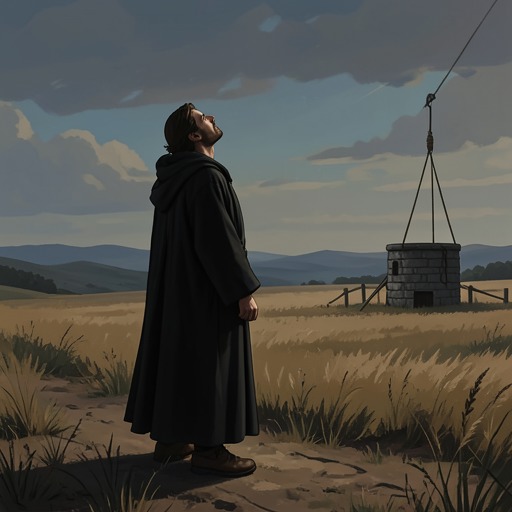
Look before you leap
Aesop's Fables“Look before you leap” is the maxim attached to the Fox and the Goat, a fable in which thirst sends the Goat into a well before he has considered how either animal can get out. Its force lies in the reversal: the Fox escapes by using the Goat as a ladder, then faults him for entering a danger with no inspected exit.
Meaning and Dramatic Illustration
The rule calls for foresight before commitment: a person should inspect not only the immediate attraction of an opportunity but also the practical means of leaving it. The well makes that principle concrete. Its water looks desirable to the thirsty Goat, but the steep walls turn an impulsive choice into a trap.
The Fox’s escape supplies the fable’s sharpest irony. He has no independent way out, so he persuades the Goat to place his forefeet against the wall and bend his head; using the Goat’s back and horns for support, he climbs to the mouth of the well. The Goat’s willingness to help becomes the means of the Fox’s rescue, while the promised assistance in return never comes.
The Maxim’s Context
The saying follows the Fox’s rebuke after the Goat upbraids him for breaking his promise. The Fox argues that the Goat should have inspected the way up before descending and should not have exposed himself to a danger from which he had no means of escape. The instruction is therefore grounded in the exact circumstances of the fable: the Goat considers his thirst and the water, but not the route back to safety.
That ending complicates the rule without weakening its practical warning. The Fox speaks as though he were merely diagnosing the Goat’s lack of foresight, yet he has deliberately concealed his predicament, praised the water, and used the Goat to escape. The fable’s lesson is thus delivered by a beneficiary of the Goat’s mistake, whose own conduct makes the warning an example of opportunistic counsel as well as prudent planning.
Place in the Fable
The maxim converts the fable’s action into a portable rule: assess a commitment before making it, especially when the consequences may be difficult to reverse. The well’s physical arrangement gives the advice its logic—the descent is easy, but escape requires a plan and help. In the narrative, the Goat learns this only after acting; the closing maxim places foresight where the character failed to exercise it, before the leap rather than after the trap.